Tuesday, 31 January 2017
Monday, 30 January 2017
Target Audience
Our target audience is primarily young adults aged 18 and over, our main focus is producing a product of interest for people with a preference for psychological aspects of films, thrillers and realistic dramas.The film we have produced aims to, in one sense, have a relatable side as the characters involved are portrayed as ordinary teenagers. However, this film allows the ability to get into a darker and deeper side of life, with the unlikeness of such events being commonly known in the real world, people interested in psychological issues or who have an intrigue for the thriller genre will ultimately enjoy the films unique features. Furthermore, we are targeting the 'outcasts' of the younger demographic as they're the most likely of audiences to have a larger interest in British Independent films because of they're reliability(through regional identity, common nationality or solely due to theme ).
Possible Distributor
Warp Films
- Independent UK film production company based in Sheffield and London with a division in Melbourne , Australia.
- Established by Warp Records founding partners Rob Mitchell and Steve Beckett.
- Involved in numerous famous British works such as This is England and Submarine.
- Films and TV shows under Warp Films have gained numerous awards such as This is England winning Best Film at the British Independent Film Awards and Dead Man's Shoes winning the South-bank award for Best Film.
- Independent film companies attract a smaller demographic, which is appropriate for our film , as psychological thrillers (especially British) are not as popular as mainstream action or comedy films.
- Warp films has worked with many different genres and is one of the main independent British production companies useful to our film.
- Filming on location (Sheffield and London )means it's less time consuming and spends less money for production, convenient for an independent film such as ours.
- Previous warp film produced films have been successful to some extent , for example '71 which grossed £2.9 million in the UK alongside gaining some popularity in the USA.

Sunday, 29 January 2017
Similar film research - Joe Sheldon
Research into films similar to my plot summary.
My movie idea revolves around the actions of a serial killer, following him from his teenage years to the eventual killing of his two best friends; his mental illness and prison friends drive him to the conclusion that he is envious of them for their success, despite one having as failing a life as him. Despite there being no films explicitly similar to this plot, films focused on serial killers have become a sub-genre of their own in recent times, developing since the 60s. The following are three films that are similar to mine and what I can draw from them.
Psycho:
Horror/Thriller film Psycho (Dir. Hitchcock, 1960) is often heralded as one of the greatest serial killer movies of all time, going down as the movie that made Hitchcock's career. The film depicts a crazed
motel owner, Norman Bates, murdering a woman who's car breaks down outside. The film's use of score is iconic, with the high pitched string noises during the infamous shower murder scene being immediately recognisable as connoting danger.
Psycho teaches that shape match editing and the use of hidden identity can be effective in creating a feeling of tension. During the shower scene, there is an edit that cuts from Marion's eyes to blood washing down a plughole, which shows a figure cleaning the scene of the crime; this helps the audience draw a relation. Furthermore, the anonymity of the figure cleaning the scene builds tension as to who the murderer is, which has become a trope of the slasher genre. Certain characters remaining unnamed is crucial to the mystery of any thriller film.
The Silence of the Lambs:
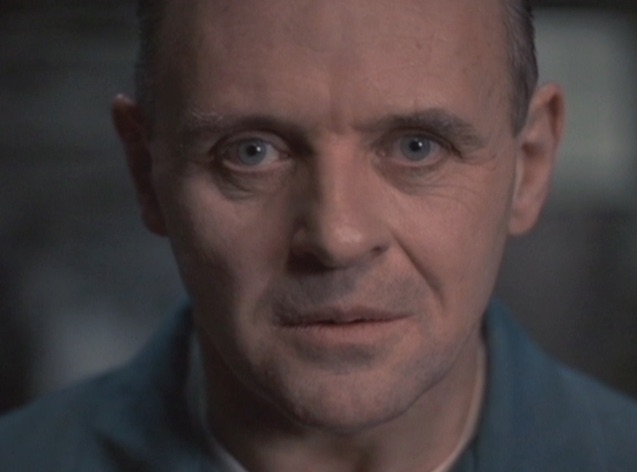
The Silence of the Lambs (Dir. Demme, 1991) is a movie that is exemplary in displaying the importance of dialogue and interaction between traditionally 'creepy' character and the protagonist. The film has various interrogation scenes between Hannibal Lecter and Clarice Starling, in which she asks him about the manner in which he committed his crimes. Without a doubt one of the greatest assets and lessons from this movie for mine is how to construct a scary character.
Hannibal has various idiosyncrasies, including his constant speak of human remains and his tongue on his teeth, which adds to his aura of fear and danger. This is important when developing my character Charlie as I intend for him to have the same aura, connoting to the audience that he is responsible for the further killings in the movie early on. Moreover, Hopkins' portrayal of the Lecter character is so scary because it is believable. He even elicits sympathy from the audience at points, acting caring toward Clarice. To script my character as equally scary, I must recreate the feat of a believable character who is also unnerving.
American psycho:
American Psycho (Dir. Harron, 1997) is a film that revolves around Patrick Bateman, an investment banker who begins to delve into his violent fantasies while hiding his alter ego from his co-workers. The film, much like mine, delves into the world of a man that wants to begin to explore his constant thoughts of murder.
American Psycho can teach us how to adapt the slasher genre for a more modern audience, as well as display both the sane and insane side of a serial killer's life. Patrick is shown as speaking and being good friends with various other office workers during the daytime, while also being a mass murderer in the evenings. While making my film, I will have to be conscious of showing the human side of Charlie, especially as he feels remorse for his killings upon his suicide. One way in which American Psycho shows this is by showing Patrick unable to kill his colleague in a bathroom when given the chance. In stage directions in the script, I should direct slight remorse on the expression of Charlie.
Wednesday, 25 January 2017
Editing (within psychological thrillers)
Montage -
A montage is selecting, editing, and piecing together separate sections of film to form a continuous whole.A montage can be used in psychological thrillers in order to highlight key scenes which bring out tension and suspense and potentially create an overview of whats about to happen.
Match Cut
This editing technique is used between two unrelated scenes and in fact shows a relationship between them, this can be used in thrillers to create a deeper understanding for the audience of why everything is in relation to itself.
Flashback -
A flash back cuts to scene set in the past , giving the audience an insight to what previously happened, this can show to audience why a character behaves a particular way or why something has happened.
Straight Cut -
A straight cut is an editing technique which allows one shot to suddenly end and the next shot to abruptly come onto the screen as well as allowing unnecessary footage to be removed or shortened. Straight cuts are used in thriller films to focus on fast paced scenes and lead us to the source of tension.
A montage is selecting, editing, and piecing together separate sections of film to form a continuous whole.A montage can be used in psychological thrillers in order to highlight key scenes which bring out tension and suspense and potentially create an overview of whats about to happen.
Match Cut
This editing technique is used between two unrelated scenes and in fact shows a relationship between them, this can be used in thrillers to create a deeper understanding for the audience of why everything is in relation to itself.
Flashback -
A flash back cuts to scene set in the past , giving the audience an insight to what previously happened, this can show to audience why a character behaves a particular way or why something has happened.
Straight Cut -
A straight cut is an editing technique which allows one shot to suddenly end and the next shot to abruptly come onto the screen as well as allowing unnecessary footage to be removed or shortened. Straight cuts are used in thriller films to focus on fast paced scenes and lead us to the source of tension.
Subscribe to:
Posts (Atom)